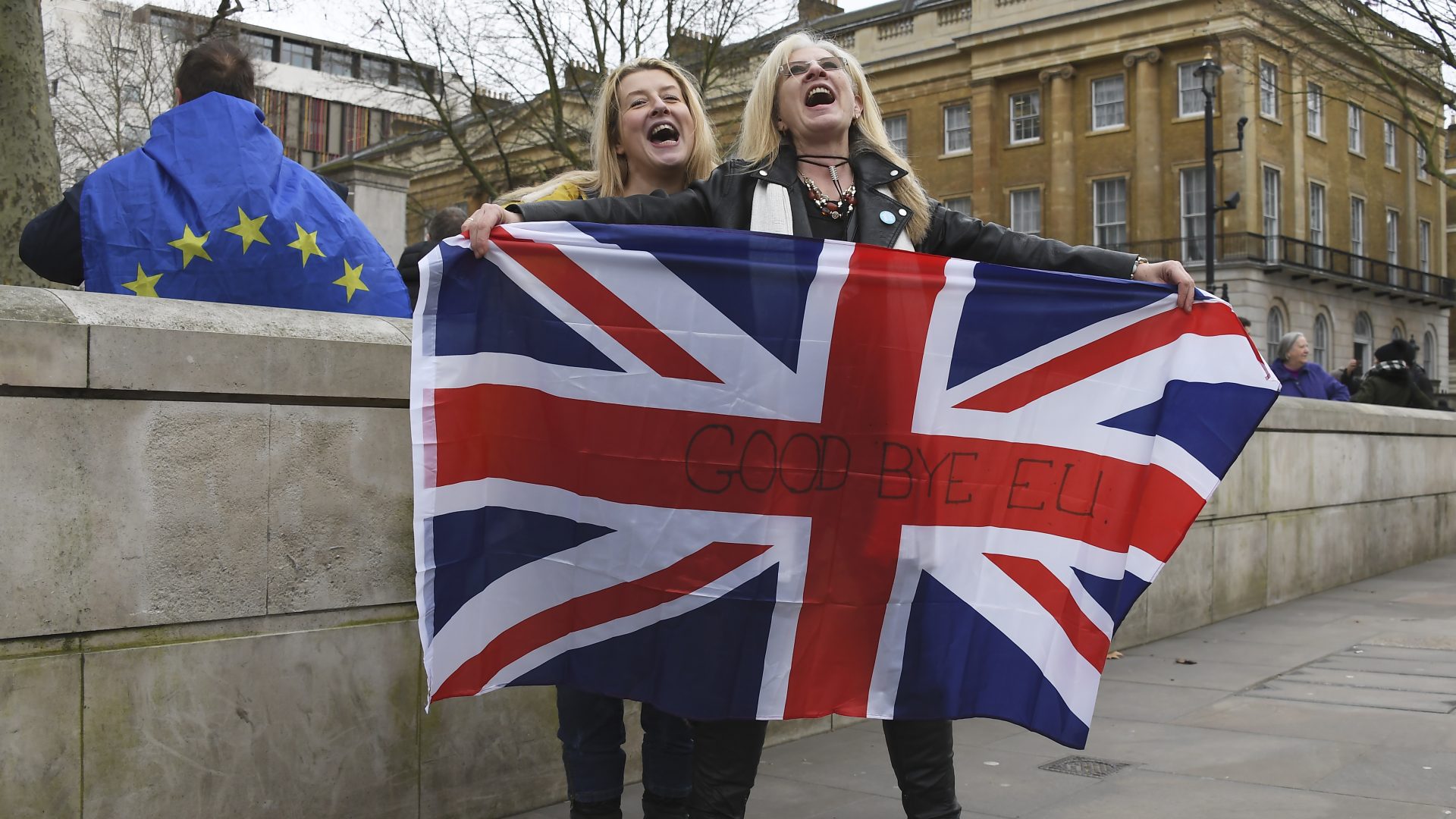
It has been a decade since the UK voted to leave the European Union.
After years of argument and negotiations the UK left the EU on 31 January 2020, on the eve of the Covid 19 pandemic.
Ten years since the vote, FactCheck looks at some of the main pledges of both campaigns and where the UK is today.
Immigration
The pledge to gain control over immigration was at the heart of the Brexit campaign.
Writing in The Times two months before the vote in 2016, key Brexit campaigner and then Justice Secretary Michael Gove said: “Because we cannot control our borders…. public services such as the NHS will face an unquantifiable strain as millions more become EU citizens.”
In the year ending March 2016, the number of people entering the UK was 803,000 according to the Office for National Statistics (ONS).
Of those, 294,000 were from the EU according to The Migration Observatory.
Since 2016 the number of people coming from the EU has declined.
However, for those who are entering from non-EU countries there has been a large uptick. This increase started in early 2021, when a new post-Brexit immigration system was introduced.
The peak of non-EU migration came in the year ending March 2023 when arrivals hit nearly 1.5 million. But since 2023 immigration has been on a downward trajectory according to the ONS.
For the year ending December 2025, the latest provisional ONS figures, immigration was 813,000 – including those from EU member states plus those from outside the trade bloc.
So far, we’ve only looked at immigration – people coming into Britain. But what about net migration – that is, those coming minus those leaving?
Net migration hit a high of 944,000 in the year to September 2023. Since then this figure has been declining. The latest available figure from the ONS has net migration for the year to December 2025 the number as 171,000. 627,000 came from non-EU counties while 76,000 came from the EU. In 2025 642,000 people left the UK.
And just looking at EU movement, the latest ONS data shows that 42,000 more EU citizens left the UK than arrived in the year ending December 2025.
While both the vote to leave and our actual exit from the EU seemed to reduce the number of people coming from the EU, this number was outweighed by those entering from non-EU countries. Since leaving the EU the UK has been able to exercise more control over immigration – and different governments have chosen to use that power differently.
So if you voted to leave to bring down immigration, you might have been disappointed. But if you wanted to give UK governments more control of immigration, your wish was granted.
Trade
The Leave campaign said that Brexit would make the UK “free to trade with the whole world”. The UK has made 40 trade agreements with 74 countries and territories around the world plus the UK-EU Trade and Cooperation Agreement since Brexit.
According to a London School of Economics (LSE) study, trade between the UK and EU dropped by between 17 and 19 per cent in both directions in the post-referendum period and before the UK had signed a deal with the EU.
However, there is a potential benefit to UK trade from Brexit: it meant we avoided the worst of Donald Trump’s trade tariffs compared to our continental neighbours.
Professor Thomas Sampson, who is an international trade expert at the LSE said in a blog post: “being outside the EU means the UK is now facing a lower tariff on its exports to the US and it’s not unreasonable to point to that as a consequence of Brexit.”
There are some aspects of the UK’s trading relationship with the EU which are yet to be fully ironed out, such as Sanitary and Phytosanitary (SPS) products. SPS products include everyday items such as fresh sausages and burgers, certain types of shellfish, and seed potatoes.
In March 2026, the government announced a new deal for SPS products. This deal is the latest example of how the Labour government has become more aligned with the EU. In May 2025 at a UK-EU “reset” summit, the pair agreed to “deeper cooperation” with each other.
In August 2025, the British Chambers of Commerce reported that “nearly half of businesses exporting services cite red tape and market access issues as key barriers post-Brexit” . One academic paper by the LSE says that “The Trade and Cooperation Agreement (TCA) [which is the deal between the UK and EU agreeing their future trading relationship] reduced total goods exports from the UK by an estimated £27bn (or 6.4 per cent) in 2022 – due to a 13.2 per cent fall in the value of goods exported to the EU.”
Logistics UK, which represents the UK haulage industry, said in 2025: “Between 2017 and 2024, total exports [of physical goods] to the EU fell by 23 per cent…. while imports from the EU declined only by 5 per cent. This suggests UK exporters have faced greater frictions post-Brexit, while imports have been more resilient.”
In relation to services, for example banking, consulting, retail and cultural activities, UK exports have performed “strongly” since Brexit in 2020 according to a House of Commons briefing paper. The research paper says services exports to the EU were up 28 per cent in 2025 compared with 2019 levels. For non-EU countries, service exports were up 26 per cent.
Despite this growth in the services sector, experts from the LSE said in June 2025: “Overall, UK services exports are estimated to be 4 to 5 percent lower, indicating that five years on, Brexit has fallen short of delivering its vision of Global Britain”.
So while we might be exporting more services than we did before Brexit, these researchers conclude that we could be even better off if we hadn’t left the EU.
Northern Ireland
As this FactCheck article from 2017 explains, the border between Northern Ireland and the Republic of Ireland has always been a complex issue. Prior to the Good Friday Agreement being signed in 1998 there had been periods of intense violence in Northern Ireland. The Troubles, as they were commonly known, were mainly relating to Northern Ireland’s place in the UK, a topic which Brexit drew into sharp focus.
On 29 February 2016, the then Mayor of London and prominent campaigner for Brexit, Boris Johnson told BBC News: “I think the situation will be absolutely unchanged” in relation to the Northern Ireland border with the Republic. When Johnson was prime minister, he told the Conservative Party Conference in 2019 that “we will under no circumstances have checks at or near the border in Northern Ireland. We will respect the peace process and the Good Friday Agreement.”
In 2017, Theresa May, who had by then entered No10, said “nobody wants to see a return to the borders of the past”.
So what actually happened?
From the end of January 2021 up until spring 2023, when Rishi Sunak brought in the Windsor Framework, if a company wanted to send goods between Northern Ireland (in the UK) and the Republic of Ireland (in the EU) they would have to have those goods manually checked, which required paperwork.
The Windsor Framework is an arrangement between the EU and the UK drawn up in order to smooth out the trading relationship for goods going to and from the UK and EU. The Framework removed barriers to goods traveling between Northern Ireland and the rest of the EU.
Since the Windsor Framework has come into force the majority of goods do not require any checks or paperwork when moving goods between Northern Ireland and the Republic of Ireland.
But it is important to note that there is still some level of additional paperwork relating to Brexit and trading in or around Northern Ireland. For example, when a business in England needs to send a parcel to another business in Northern Ireland, it must submit information to the Customs Declaration Service.
In 2026, there is no hard border between Northern Ireland and the Republic of Ireland. Due to the unique position of Northern Ireland in the UK, Northern Ireland can trade freely with both the EU and the UK. People can cross the border in the same way which they could before Brexit. However, there are still some checks on some goods which are a direct result of Brexit.
Economy
On the Remain side, the Treasury released a report on “the immediate economic impact of leaving the EU” ahead of the 2016 referendum.
In the report, the then-chancellor, George Osborne said that “a vote to leave would represent an immediate and profound shock to our economy”, pushing the UK into recession and leading to “around 500,000” people losing their jobs.
It is worth noting that the Treasury report was written on the assumption that Article 50, the start of the formal process of leaving the EU, would be triggered as soon as the result was known.
But in the end, this did not happen straightaway – it was only triggered on 29 March 2017 by Theresa May. So it’s hard to know whether the lack of an instant recession following the vote disproves the Treasury analysis, or whether holding off on Article 50 helped mitigate the economic shock.
According to an academic paper by the National Bureau of Economic Research entitled “The Economic Impact of Brexit” the UK economy was approximately 8 per cent smaller in 2025 than it would have been if the UK had remained in the EU. The same study also says both employment and productivity are 3-4 per cent lower than they would have been, with business investment 12 to 18 per cent smaller.
A separate study by Warwick Business School found that between 2016 and 2019, a period when the UK was technically part of the EU but figuring out the best way to leave, around £22 billion of investment was lost to the EU. The study finds that this investment would have led to the creation of 100,000 jobs, many of which would have been in “high value” sectors such as banking and professional services.
Whilst the Remain campaign’s more pessimistic claims about immediate recession and mass job losses didn’t materialise, a number of prominent business surveys and academic papers have found that Brexit negatively affected the UK economy compared to staying in the EU.
For more analysis of how Brexit has affected the UK, you can watch our Foursight team’s YouTube documentary here. Kiran Moodley explores the impact of Brexit further and interviews one of the main architects of the Vote Leave campaign, Lord Elliott.