$26bn deal to help a million struggling US homeowners
 Matt Frei
Europe Editor and Presenter
Matt Frei
Europe Editor and Presenter
The US government has announced a $26bn deal with five of the country’s biggest banks that could help more than one million current and former American homeowners in foreclosure.
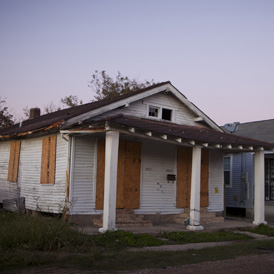
Since 2008 I have been to dozens of housing estates called names like Meadowcroft, Paradise Creek and, yes, Brookside.
Some are marooned in the desert around Las Vegas like lunar colonies. Another was on the edge of the Florida Everglades, where the biggest threat – before the economy decided to tank – were alligators and pythons lying in prey of household pets.
Wherever they were and whatever their name in so many of these suburban idylls the American Dream has been turned into a nightmare of foreclosures. The green shoots of nouveau poverty are the uncut lawns and untrimmed hedges of empty houses, proof that even the bank, which now owns the foreclosed property, has stopped paying someone to keep up appearances.
The foreclosure signs are the tombstones of this crisis. They are to the Great Recession what soup kitchens were to the Great Depression: the abiding image, the most glaring consequence of an economy inflated by outlandish dreams of property ownership.
Since 2008 American homes have gone into foreclosure because the property was worth less than the mortgage owed on it or because the mortgagee had lost a job and could no longer keep up with the monthly payments. It is this more than anything that has crippled the US economy and bled consumer confidence. The foreclosure crisis is still the biggest drag on the spluttering recovery.
The property bubble was always going to burst in an unpleasant way. There was always going to be a rash of foreclosures. But in 2010 it emerged that the crisis was made so much worse by the shoddy yet systemic practice of a number of big banks and mortgage lenders who were so overwhelmed by the mountain of late payments that they cut corners on an industrial scale.
Millions of documents were ignored, signatures were forged, or letters were answered by machines rather than a real, live mortgage officer who had scrutinised the cases. We still don’t know how many homes could have been saved from foreclosure if the banks had been less rash. The banks themselves suffered because they would much rather have recovered some of the money owed by agreeing on a short sale, which is less costly and complicated for everyone concerned.
Intimidated as most of us are by the power of banks, especially when it comes to mortgages, the vast majority took the banks judgement as gospel. It was an inexcusably slap-dash way of dealing with people’s homes and everything that signifies. It also added insult to the injury caused by banks, who had by the time the scandal broke, already been bailed out by the very taxpayers they had abused and were beginning once again to sit on piles of cash while being reluctant to do what they were supposed to do, which is extend credit judiciously.
The agreement signed between the administration, 49 states and five big banks took a year to hammer out. It stands so far at 26 billion dollars, although that number could rise significantly. It will give some relief to millions of Americans who were mistreated by their banks, although it won’t restore the roof over their heads.
This settlement has been likened to the tens of billions of dollars the tobacco industry had to pay out to states for the treatment of cancer sufferers. It is certainly a humbling financial blow to the banks, although I have no doubt that their customers will be made to pay for it through the incremental creep of ATM charges or overdraft fines. President Obama, who has long realised that bashing the banks also gives him political capital may get another bounce to what have become rising numbers in the opinion polls.
But what the historic settlement will not change is the negative credit rating that millions of Americans have been landed with for seven years at least because of a foreclosure that may have been averted.
It is only when you land in the USA that you appreciate the importance of credit ratings. Negative numbers become like indelible stains on your personality, making it difficult to get a deserving mortgage or loan, or hiking up the cost prohibitively. “What’s your credit score?” is a common question to which most Americans now need to know the answer.
-
Latest news
-
Police try to shut down right-wing event as Nigel Farage speaks3m

-
‘Many things Netanyahu has done I disagree with, but I’m not giving up on Israel’, says top-ranking Democrat4m
-
Could US House be about to vote on Israel, Ukraine aid bill?2m
-
Number of people out of work due to long-term sickness at record high3m
-
Creating deepfake porn to be made a criminal offence after C4 investigation6m
-


